

PISÉO was approached by a client in the automotive sector to optimize a head-up display (HUD) system. Although operational, this system did not meet the car manufacturer’s requirements.
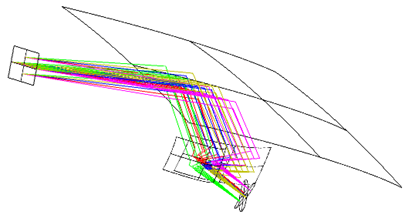
The device in question used an optical concept based on the projection of an image via two curved mirrors and an output window, which was then reflected onto the windshield. This system had to meet strict criteria imposed by the customer, such as overall size and visibility characteristics, while maintaining high image quality. In order to meet the car manufacturer’s objectives, the customer called on PISÉO to optimize its head-up display. After a critical analysis of the existing system (performance and construction), PISÉO’s engineers developed an optical design that solved the problems identified.
A HUD (Head-Up Display) is an augmented reality device that projects information directly into the driver’s field of vision, in this case onto the windshield. This type of technology, commonly used in the automotive industry, also has applications in defense, healthcare, manufacturing, and video games via augmented reality headsets.
The UHD system that PISÉO has been working on consists of an OLED screen, a set of mirrors, and the windshield as a projection screen. Each component must be optimized to provide excellent image quality that is legible and free of stray light, while meeting constraints in terms of space, environment, industrialization, and cost.
To meet the customer’s specific needs, PISÉO engineers used Zemax OpticStudio optical design and simulation software. The main focus was on the mirrors, a key factor in meeting space constraints while maintaining high image quality.
PISÉO engineers modeled the optical system in Zemax, optimized the design using their extensive experience in the field, and simulated the achievable performance. This work also made it possible to anticipate and correct recurring problems in augmented reality systems, such as ghost images, luminance management for day and night visibility, and distortion minimization. This optical design was carried out taking into account the industrial feasibility of the optics and the target cost.
PISÉO has a laboratory specializing in imaging and regularly conducts image quality tests on AR/VR/MR headsets and HUD systems. The prototype provided by the customer was subjected to various tests, including:
- Spatial resolution
- Contrast
- Distortion
- FOV
- DOV
- Luminance and uniformity
These tests validated the optical design of the HUD system and enabled industrial optimization of the product.
Head-up display (HUD) systems are complex optical devices that must meet numerous technical constraints, particularly when used in vehicles.
Thanks to its expertise and technical resources, PISÉO supported this customer from the feasibility study to industrialization, demonstrating its ability to design low-cost, optimized, and industrializable embedded optical systems. These solutions meet the strict requirements of automotive manufacturers.
Please do not hesitate to contact us for any optical system design and optimization project. We will meet your needs and expectations from concept to manufacture.